How to File a Commercial Roof Insurance Claim in Georgia
Filing a commercial roof insurance claim in Georgia can mean the difference between a fully covered repair and tens of thousands of dollars out of your operating budget. As a property manager, facility manager, or business owner in Metro Atlanta, you need more than generic advice—you need a process that actually works with Georgia insurance regulations and the specific challenges of documenting damage on flat and low-slope commercial roofs. After navigating hundreds of commercial claims across Cobb, Cherokee, and Gwinnett Counties, we’ve seen what separates approved claims from denied ones. The contractors who understand how to file a commercial roof insurance claim in Georgia know that documentation timing, adjuster coordination, and material-specific damage assessment are everything. This guide walks you through the exact five-step process we use with our commercial clients—from the moment storm damage occurs to the final settlement check. Whether you manage an apartment complex, retail center, warehouse, or HOA community, these steps will help you maximize your claim and minimize business disruption.
When to File a Commercial Roof Insurance Claim in Georgia
Not every roof issue warrants an insurance claim, and filing for the wrong type of damage can actually hurt your standing with your carrier. Understanding what Georgia commercial property insurance typically covers—and what it excludes—helps you make the right call before involving your insurer.
Common covered events for commercial roof damage in Georgia include hail storms, high winds, fallen trees, lightning strikes, and severe weather events. Metro Atlanta experiences significant hail activity during spring months (March through May) and faces hurricane-related wind damage from late summer through fall. These sudden, weather-related incidents are precisely what commercial property insurance is designed to cover.
The critical distinction is between sudden damage and wear-and-tear exclusions. Insurance covers damage from specific, identifiable events—not gradual deterioration from age, poor maintenance, or deferred repairs. If your TPO membrane has been slowly degrading for five years, that’s not a claim. If a hailstorm punctured that same membrane last Tuesday, it absolutely is.
Georgia law sets specific time limits for filing claims, typically requiring notification within one to two years of the damage event, depending on your policy. However, insurers can deny claims if you waited unreasonably long to report damage that worsened over time. Our recommendation: contact your carrier within 24-48 hours of discovering storm damage. If you’ve experienced recent severe weather, schedule a free commercial roof inspection immediately to determine if a claim is warranted.
Step 1: Document the Damage Before Anything Else
The single biggest mistake we see commercial property managers make is insufficient documentation. Adjusters base their assessments on evidence, and the evidence you gather in the first 48 hours often determines your claim’s success. This is especially true for flat roofs where damage isn’t visible from ground level.
Photograph all visible damage from multiple angles, including wide shots that show the overall roof area and close-ups of specific damage points. For large commercial properties—apartment complexes, warehouses, office parks—drone photography is invaluable. Aerial images capture the full scope of damage across thousands of square feet that would be impossible to document from a ladder.
Create a written damage log that records:
- Date and time the damage occurred (or was discovered)
- Weather conditions during the event (wind speeds, hail size if known)
- Specific locations of visible damage on the roof
- Interior leaks, water stains, or ceiling damage
- Any business disruption or tenant complaints resulting from the damage
If safely accessible, keep samples of damaged materials—torn membrane sections, dislodged flashing, broken skylights. This physical evidence helps adjusters verify the damage mechanism and can prevent disputes about whether damage was storm-related or pre-existing. Our storm damage restoration team can assist with proper documentation if you’re unsure what to capture.
Step 2: Schedule a Professional Roof Inspection
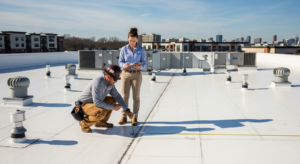
A professional commercial roof inspection differs significantly from residential inspections. Commercial roofs—particularly flat and low-slope systems using TPO, EPDM, or modified bitumen—require specialized knowledge to assess properly. Damage that would be obvious on a shingle roof can be nearly invisible on commercial membranes without trained eyes.
What inspectors look for on commercial roofing systems:
| Roofing Material | Common Storm Damage Signs | What Adjusters Often Miss |
|---|---|---|
| TPO Membrane | Punctures, seam separation, membrane tears | Bruising that weakens membrane without visible holes |
| EPDM Rubber | Hail impacts, lifted seams, flashing damage | Micro-fractures that lead to delayed leaks |
| Modified Bitumen | Granule loss, cracks, exposed substrate | Accelerated aging from hail impact points |
| Metal Roofing | Dents, punctures, fastener damage | Panel warping that compromises waterproofing |
A thorough inspection report from a qualified commercial roofing contractor strengthens your claim substantially. The report should include itemized damage with locations marked on a roof diagram, photographs of each damage point, and a detailed scope of work with material specifications. This documentation gives your adjuster exactly what they need to approve an accurate settlement—and gives you leverage if the initial estimate falls short.
Step 3: File Your Claim and Prepare for the Adjuster
Once you have documentation from your initial assessment and professional inspection, it’s time to formally file your commercial roof damage claim. Speed matters here—not just for meeting policy deadlines, but because prompt notification demonstrates good faith to your insurer.
Contact your commercial property insurance carrier within 24-48 hours of confirming storm damage. When you call, have the following information ready:
- Policy number and property address
- Date and type of weather event that caused damage
- Brief description of damage observed
- Your professional inspection report (or scheduled date)
- Contact information for your roofing contractor
Request a complete copy of your policy if you don’t have one readily accessible. Understanding your coverage limits, deductible amount, and whether you have actual cash value (ACV) or replacement cost coverage is essential before negotiating any settlement. Commercial policies often have sub-limits for specific roof types or age-based depreciation schedules that affect your payout.
When the insurance company assigns an adjuster, schedule their visit for a time when your commercial roofing contractor can be present. This is not optional—it’s one of the most important steps in the entire process. The adjuster visit typically happens within 5-10 business days of filing, so coordinate schedules early.
Step 4: Meet with the Insurance Adjuster On-Site
The adjuster meeting is where claims are won or lost. Having your commercial roofing contractor present levels the playing field and ensures all damage is properly identified and documented in the adjuster’s report.
Why contractor presence matters: Insurance adjusters handle dozens of claims weekly across all property types. They may not have specific expertise in commercial flat roof systems, and they’re often working under time pressure. A knowledgeable contractor walks the adjuster through damage systematically, explains damage mechanisms specific to your roofing material, and points out issues that generalist adjusters commonly miss.
For flat commercial roofs, hidden damage is the norm rather than the exception. Ponding water areas may mask membrane punctures. Hail impacts on TPO can create internal bruising that won’t leak immediately but will fail prematurely. Seam integrity issues from wind uplift may not be visible without close inspection. Your contractor knows where to look and how to document findings in terms adjusters understand.
Before the adjuster leaves, request their preliminary assessment in writing or at least verbal confirmation of what they observed and documented. Take notes on anything they missed or disagreed about—you’ll need this information if you file a supplement later. Our roof insurance claim assistance program includes attending adjuster meetings for exactly this reason.
Step 5: Review the Settlement and Negotiate if Needed
After the adjuster visit, your insurance company will issue a settlement offer—typically within 1-3 weeks for commercial claims. Review this document carefully before accepting anything. Initial offers on commercial roof claims are frequently below the actual repair cost.
Understanding ACV vs. replacement cost coverage:
| Coverage Type | What It Pays | Implications for Commercial Roofs |
|---|---|---|
| Actual Cash Value (ACV) | Replacement cost minus depreciation | Older roofs may receive significantly reduced settlements |
| Replacement Cost Value (RCV) | Full cost to replace with similar materials | Full repair/replacement covered, often paid in two installments |
Common reasons commercial claims get underpaid:
- Adjuster missed damage points during a rushed inspection
- Scope of work doesn’t include required items (decking replacement, code upgrades)
- Excessive depreciation applied to roofing materials
- Legitimate damage classified as “pre-existing” without proper investigation
If the settlement falls short of your contractor’s detailed estimate, file a supplement with additional documentation. Include your contractor’s itemized scope of work, photographs the adjuster may have missed, and a written explanation of the discrepancy. You can request a re-inspection or invoke your policy’s appraisal clause if direct negotiation stalls. Don’t accept an inadequate settlement—commercial roof repairs are too expensive to absorb the shortfall from your operating budget.
How a Commercial Roofing Contractor Simplifies the Process
The commercial roof insurance claim process has multiple points where specialized contractor involvement makes a measurable difference in your outcome. Contractors who focus on insurance restoration understand exactly what adjusters need to approve claims quickly and accurately.
Pro Roofing & Siding provides comprehensive claim support for commercial property managers throughout Metro Atlanta. Our process includes:
- Thorough damage documentation with drone photography and detailed reports
- Itemized repair estimates formatted for insurance submission
- On-site presence during adjuster inspections
- Supplement preparation and negotiation support
- Coordination of repairs with claim approval timelines
For property managers overseeing multiple buildings—apartment complexes, HOA communities, retail centers—we understand that minimizing business disruption matters as much as the claim settlement itself. We work with your approval timeline to schedule repairs that don’t interfere with tenant operations or lease obligations.
For approved claims, there are typically no out-of-pocket costs beyond your policy deductible. Our team handles the insurance coordination so you can focus on managing your property rather than managing paperwork.
Why Choose Pro Roofing & Siding for Commercial Insurance Claims
Pro Roofing & Siding has built a reputation across Metro Atlanta for commercial roofing excellence and insurance claim expertise. Our 4.8-star rating from 282+ reviews reflects our commitment to quality work and responsive service for property managers, facility managers, and business owners throughout Cobb, Cherokee, and Gwinnett Counties.
As a GAF Master Elite certified contractor—a distinction held by only 3% of roofing contractors nationwide—we bring manufacturer-backed expertise to every commercial project. This certification matters for insurance work because it demonstrates verified installation quality and provides enhanced warranty options for your replacement roof.
Our commercial roofing team specializes in TPO, EPDM, modified bitumen, and metal roofing systems. We understand the specific documentation requirements for each material type and know how to present damage findings in terms that move claims forward. From apartment complexes in Marietta to warehouse facilities in Lawrenceville, we’ve successfully navigated the Georgia commercial insurance claim process hundreds of times.
Frequently Asked Questions
What types of commercial roof damage does insurance cover in Georgia?
Georgia commercial property insurance typically covers sudden, accidental damage from hail, wind, fallen trees, lightning, and severe storms. This includes punctured membranes, wind-lifted seams, hail-damaged flashing, and structural damage from fallen debris. Normal wear and tear, gradual deterioration, and damage from deferred maintenance are excluded. The key factor is whether damage resulted from a specific, identifiable weather event rather than long-term aging.
How long do I have to file a commercial roof insurance claim in Georgia?
Most Georgia commercial property policies require claims to be filed within one to two years of the damage event. However, waiting can work against you—insurers may argue that delayed reporting allowed damage to worsen or that you failed to mitigate further harm. Best practice is to notify your carrier within 24-48 hours of discovering storm damage and schedule a professional inspection immediately.
Should my roofing contractor be present during the insurance adjuster visit?
Absolutely. Having a qualified commercial roofing contractor present during the adjuster inspection significantly improves claim outcomes. Your contractor can identify damage that generalist adjusters miss—especially on flat roof systems where damage is often hidden—and explain repair requirements in technical terms that support accurate estimates. This is standard practice for commercial claims and is one of the most valuable services a restoration contractor provides.
What happens if my commercial roof insurance claim is denied or underpaid?
If your claim is denied, request a written explanation of the denial reason and review it with your roofing contractor. Many denials result from insufficient documentation, which can be remedied by filing additional evidence. For underpaid claims, submit a supplement with your contractor’s detailed estimate, additional photographs, and an itemized explanation of the discrepancy. If negotiation fails, your policy likely includes an appraisal clause that provides for independent damage assessment.
Does filing a roof claim increase my commercial property insurance premium?
Filing a single weather-related claim typically does not result in premium increases, as these are considered “Acts of God” beyond your control. However, multiple claims within a short period may affect your rates or renewability. The decision to file should be based on damage severity relative to your deductible. If repair costs are only marginally above your deductible, paying out of pocket may make more financial sense than filing a claim.
Schedule Your Free Commercial Roof Inspection
If your commercial property in Metro Atlanta has experienced recent storm damage—or you simply want to know your roof’s current condition before the next severe weather event—Pro Roofing & Siding offers complimentary inspections for commercial property managers and business owners. Our detailed assessment includes documentation suitable for insurance submission if damage is found.
Call (770) 415-2297 today to schedule your free commercial roof inspection. Our team serves property managers, HOA boards, facility managers, and business owners throughout Cobb, Cherokee, and Gwinnett Counties. Let us help you navigate the Georgia commercial insurance claim process and protect your property investment.
Free Inspection — No Obligation
Book Your Free Commercial Roof Inspection
Ready to protect your property? Fill out the form and our commercial project team will reach out within one business day to schedule your complimentary inspection — no obligation, no pressure.
- ✓ Licensed & insured commercial roofing crew
- ✓ Detailed written assessment provided
- ✓ Serving Metro Atlanta & surrounding counties